Schools and sporting activities programs operate on trust fund. Moms and dads hand over their youngsters anticipating they will be challenged, sustained, and safe. Many days that trust fund is well placed. After that a child collapses on the sideline, a student has an extreme allergic reaction in the snack bar, or a kindergarten course explores a jar of switches with curious fingers. The moment shifts, and training comes to be the distinction in between panic and calm action. This is why first aid and CPR training belongs at the center of professional prep work for teachers and instructors, not on the margins.
I have actually functioned alongside instructors, athletic supervisors, and club volunteers long enough to have actually seen the range, from perfectly managed emergency situations to unpleasant could‑have‑beens. The throughline is easy: people that have taken a strong first aid course, exercised their CPR, and maintained their skills present have a tendency to act faster and far better when mins issue. That self-confidence is infectious. It steadies teams, reassures households, and, at times, saves lives.

What adjustments when personnel are trained
Training develops perception. Before I finished my initially comprehensive first aid and CPR course, I underestimated exactly how rapidly a scene can develop. A secondary school gamer clip-tackled from behind looked rattled however great, after that minutes later on was puzzled, irritable, and nauseated. A trained aide trainer detected the warnings for trauma, drew the professional athlete instantly, and strolled me with a straightforward, structured analysis. That professional athlete's parents still thank her. Knowledge transforms unclear fear into a sequence of clear actions.
Training likewise integrates groups. In a well-drilled school, the front office understands that gets hold of the AED, the trainer delegates crowd control, the instructor calls emergency services with the exact area and access point for paramedics, and the first aid kit shows up stocked and useful. It is not magic. It is muscle mass memory constructed in cpr training and first aid courses that imitate the noise and pressure of real incidents.
Finally, training collections standards. When brand-new staff see that a first aid certificate is anticipated, that cpr correspondence course dates live on the shared schedule, and that drills are dealt with seriously, they adapt. Safety and security culture ends up being an everyday habit instead of a conformity box.
The real emergency situations schools and groups face
Not every emergency is a remarkable collapse with an AED sprint. The pattern in education is a spin of smaller problems stressed by unusual yet high‑stakes events. A smart first aid and cpr course gets ready for both.
The typical situations appear in every term. Nosebleeds that will certainly not quit after 5 minutes of stress. Sprained ankles from missteps on stairways or turf. Finger lacerations from a woodworking class. hurts that swell ominously. Hyperventilation after a panic attack. Bronchial asthma flares during warm‑ups when the inhaler was neglected. Head knocks that initially look benign. Dehydration and warmth pains throughout early‑season practices. These are rarely newsworthy, yet they eat time and focus. With training, a teacher or coach moves briskly through key studies, applies tidy injury treatment, checks vitals, and papers the case. Without training, the same occasions cascade right into uncontrolled scenes, parents employed a thrill, and kids left with avoidable complications.
Then there are the low-frequency, high-impact circumstances. Cardiac arrest in youths is uncommon, yet it occurs, commonly pertaining to undiagnosed conditions or a sudden commotio cordis after an impact to the upper body. Motivate CPR combined with very early defibrillation can triple survival prices. Severe anaphylaxis after a food exposure is much more prevalent than most personnel anticipate, and mins count before a respiratory tract tightens. Spinal injuries in call sporting activities are rare, yet messing up a downed athlete with neck discomfort has damaging possibility. Diabetic emergencies, seizures, and warm stroke complete the list. A thoughtful cpr course and first aid training do not simply educate techniques. They instruct sequencing and restriction, just how to do just enough and prevent unsafe improvisation.
What robust training really covers
Good service providers do not sink you in jargon. They develop a useful toolkit. The very best first aid and cpr courses share common functions even if the tags vary by nation or accrediting body.
- A basic strategy to scene security and key assessment that comes to be force of habit. Check responsiveness, telephone call for assistance, open up the airway, appearance, listen, and really feel. You exercise till it really feels almost dull, because uniformity under tension is what you want. Core CPR abilities for grownups, youngsters, and infants, consisting of single‑rescuer and group approaches, with comments devices that correct rate and deepness. You find out when to use an obstacle device, exactly how to switch compressors without losing rhythm, and how to incorporate an AED within seconds. Management of choking in all age groups. You drill stomach thrusts, back blows for infants, and the shift from obstruction to unresponsiveness without avoiding beats. First help for bleeding, consisting of direct stress, dressings, and tourniquet usage. Numerous colleges still shy away from tourniquets. Modern assistance supports them when severe blood loss will certainly not stop with pressure. Personnel need hands‑on practice to develop comfort. Recognition and look after head, neck, and spinal column injuries. You rehearse verbal stablizing commands and safe roll methods for breathing assessment when essential, while finding out when not to relocate someone. Medical emergency situations probably in schools: bronchial asthma, anaphylaxis, diabetes mellitus, seizures, fainting, and warm health problem. You find out to utilize epinephrine auto‑injectors properly, identify hypoglycemia versus hyperglycemia in functional terms, and handle post‑ictal students with dignity and safety. Injury administration basics: sprains, stress, fractures, dental trauma, eye injuries, and burns. You exercise splinting with materials you really have on site, not simply perfect gear from a training room. Communication and paperwork. Who calls whom, what to claim to dispatch, what times to keep in mind, how to hand off to EMS concisely.
Courses differ in size and focus. A common combined first aid and cpr course runs four to six hours, with pre‑learning finished online. Extra intensive accreditations for coaches can run a complete day. The secret is time on task. 10 mins of chest compressions with actual feedback instructs more than an hour of lecture.
Why teachers and coaches call for a customized lens
Students are not tiny adults. The physiology, the psychology, and the context are different. Educators and instructors additionally have special restraints: course ratios, multiple synchronised obligations, and an obligation of care spread across rooms as differed as scientific research labs, play grounds, buses, and away game venues.
In elementary settings, choking tops the danger listing, adhered to by play area injuries and moderate head injury. Teachers need an eye for refined warning signs of deterioration: a kid that takes out, complains of "stomach ache," or drifts to rest after a head bump. In upper grades and sports, the profile changes to musculoskeletal injuries, blasts, warm disease, and periodic cardiac or respiratory emergencies. Instructors should juggle athlete treatment with game administration, group behavior, and the logistics of large areas or gyms where response time differs by where the AED hangs.
A general first aid course may skim these nuances. Programs constructed for educators and trains address the edge situations: exactly how to handle a downed professional athlete when challengers maintain heating up nearby, exactly how to keep bystanders from crowding a student in distress without escalating tension, or how to collaborate with a school registered nurse when she is covering numerous buildings.
The AED inquiry that keeps coming up
An automated external defibrillator is just beneficial if 2 problems are met. It has to be physically accessible within a brief stroll, and personnel must be willing to use it. I have seen schools with AEDs secured the front office, a vacant corridor a hundred meters from the sports fields. One minute of hold-up for retrieval, one minute to run back, half a min to open the situation and use pads, and you have actually currently burned valuable time. The objective several districts embrace is a two‑to‑three‑minute complete time from collapse to initial shock if suggested. Practicing that sprint matters.
AEDs do not require sophisticated qualification to run, yet confidence makes deployment faster. An excellent cpr training module consists of repetitions with the specific version your college owns, due to the fact that the pad placement representations, voice motivates, and button format vary. People freeze much less when the tool really feels familiar. Team also need to recognize that AEDs analyze heart rhythms and will certainly not shock a person with a typical heart beat, which counters a persistent worry of doing harm.
Legal and plan angles managers should weigh
Policy decisions shape outcomes greater than posters on walls. Some territories mandate first aid and cpr courses for instructors and trainers, others leave it to districts. Regardless of the law, the responsibility danger does not disappear with lack of knowledge. The safer footing hinges on recorded training, clear procedures, and devices upkeep logs.
Good Samaritan securities usually cover lay responders who act in good faith and within their training. The expression within their training issues. Finishing a recognized first aid and cpr course, maintaining a valid first aid certificate, and complying with educated procedures strengthen that legal guard. Conversely, ad‑hoc practices that contradict advice, like giving medications not suggested or relocating a thought back injury without reason, can wear down it.
Administrators should also establish refresh cycles that show skill decay. Research study recommends CPR performance weakens in as little as six months without technique. Yearly refresher courses for crucial workers, supplemented by short, quarterly skill run‑throughs, healthy college schedules better than waiting 2 or 3 years. The cpr refresher course does not require to be a marathon. Thirty minutes with a manikin and AED instructor makes a quantifiable difference.
Building a sensible training plan for a college year
Bringing every person to a full‑day session yearly is perfect and commonly unwise. Schedules, substitutes, and budgets resist. The practical plan blends depth and frequency.
Core personnel must have full certification through a first aid and cpr course: front workplace, school registered nurse, principals and assistant principals, PE staff, and all head trains. The majority of programs can license this mate right before the year starts, with an alternative to grab laggers mid‑term. Class educators gain from the same accreditation, however if resources are limited, begin with those managing higher‑risk activities: scientific research laboratories, technology workshops, school outing leads, and recess monitors.
Then layer in micro‑drills. Five mins at a team meeting to practice the emergency address manuscript for calling dispatch. A brief after‑practice session where the group supervisors practice obtaining and turning on the AED. Situation cards in instructors' binders that timely fast run‑throughs: a professional athlete falls down on the back of the field, the bus driver radios a student seizing in the back row, a lunch duty instructor lacks epinephrine after a second exposure. Technique matters greater than perfect manuscripts, since genuine scenes twist.
Finally, track expiries and package condition as if they were attires and schedules. AED pads and batteries end on predictable cycles. First aid sets consume supplies secretly. Somebody has to own the list and the calendar, and management requires to protect time for that work.
Working with a training service provider that recognizes schools
Not all companies are developed for the education and learning and sporting activities context. When seeking first aid training, ask candid inquiries. Will they tailor scenarios to pupil ages and institution settings? Do they bring responses manikins that measure compression deepness and price, or is it a passive session? Can they incorporate your AED Take a look at the site here design into method? Do they cover epinephrine auto‑injector usage and legal considerations? Just how do they deal with blended discovering for personnel with restricted schedule? Referrals from neighboring colleges matter greater than marketing.
Some areas have actually established companions like First Aid Pro and comparable organizations recognized for receptive scheduling and useful sessions. What you want is a cpr course that operates on time, respects grown-up students, and leaves individuals a little exhausted in the arms from method, not polished from slides. The better courses integrate in small‑group turnings, turn functions, and leave space for questions that appear the unpleasant truths educators encounter, like being alone with 28 pupils while dealing with an emergency.
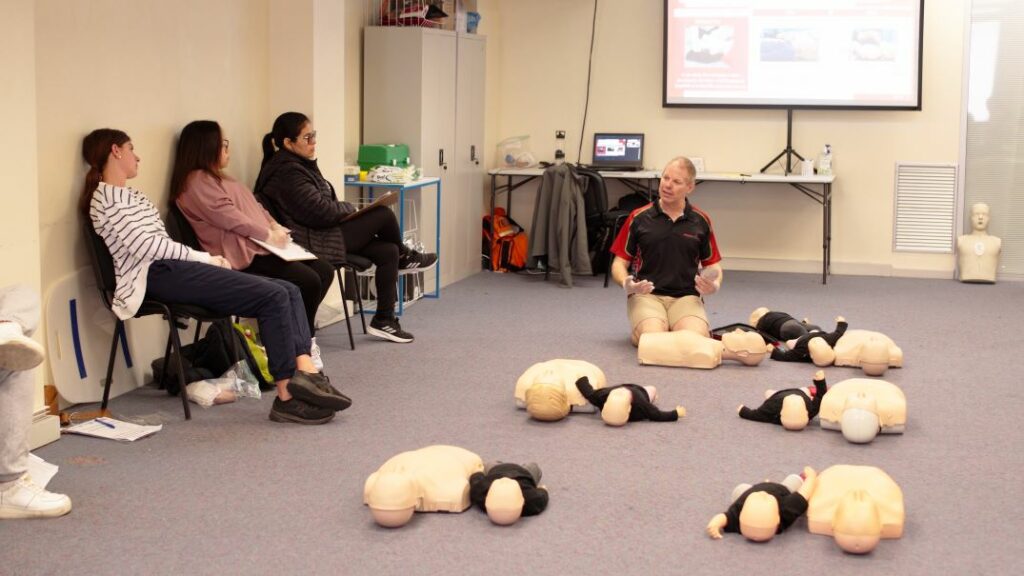
When ideal method satisfies the unpleasant truths of college life
You can design a perfect emergency action plan on paper, after that see it hit corridor blockage, a secured gate, or a substitute instructor covering 2 courses. The real world requires backup strategies and judgment.
Consider the traditional dilemma on a football pitch. A player drops, motionless. The local coach carries https://jsbin.com/?html,output a first aid set but the AED goes to the health club door. The aide is taking care of warm‑ups at the far sideline. 2 parents are floating, one says she is a registered nurse. Training aids you sort the priorities. Initially, examine responsiveness and breathing. If the professional athlete is not taking a breath generally, send out the nearby qualified person for the AED and call emergency situation solutions with the area's particular entrance access point. Start CPR without delay. Delegate group control to the aide or the most even‑keeled parent. If the proclaimed registered nurse demands taking over, verify promptly and collaborate, not complete. Your job is not to have the scene, it is to guarantee it moves.
Another edge instance resides in classrooms. A trainee with a well-known serious allergic reaction begins coughing after a birthday treat shows up. His epinephrine pen sits in the nurse's workplace. This is not a time for disputes about policy violations. Trained staff comply with the plan: ask the pupil where his pen is if he can talk, instruct an associate to run, keep track of breathing, prepare to make use of a school supply if readily available and accredited, and call emergency situation solutions early. Paperwork can wait. The pulse of first aid is act, after that explain.
Heat provides its very own puzzle. Early period conditioning brings athletes that run out form and excited. Warmth disease creeps, after that attacks. Instructors with good training identify that a talkative professional athlete who quits sweating, looks ashen, or experiences battering headache might be going across right into heat exhaustion or even worse. The feedback is active cooling currently, not a gentle stroll to the locker area. Shield, get rid of excess gear, chilly damp towels or ice to the neck, underarms, and groin, and cool fluids if the professional athlete is alert and can ingest. If there is any kind of problem for heat stroke, you cool aggressively and call for transportation. It is simple to underreact because the athlete is awake. Training fixes that bias.
Equity and inclusion in emergency situation response
Not every student signals distress similarly. Language obstacles, neurodiversity, and social standards shape just how youngsters request for aid and exactly how adults interpret habits. A student on the range could not make eye get in touch with or might manuscript language that seems like defiance when they are terrified. A newly gotten here pupil might not have the vocabulary to describe breast tightness, instead pointing or using an acquainted word that misguides. Training that highlights these facts boosts care.

Equipment decisions ought to mirror inclusion as well. Supply both grown-up and pediatric AED pads. Keep inhaler spacers sized for tiny faces. Make sure epinephrine auto‑injectors include both junior and common doses if your jurisdiction allows supply supplies. Coaches working with professional athletes who put on hijabs or various other spiritual garments ought to exercise respectful, effective accessibility to the upper body for AED pad placement while keeping self-respect, utilizing towels or teammates as screens when feasible. You learn these touches from teachers that have been in the area, not from common slides.
The cycle of self-confidence: exactly how refresher courses maintain skills alive
After a huge event, every person assures to stay existing. 6 months later, the information discolor. This is not a moral failure, it is exactly how memory functions. Muscle memory rots without use. Refresher course practice, little and usually, preserves competence.
The cpr refresher course does greater than reset a certification. It remedies drift. Compressions slow down or quicken with time. Hands creep to the incorrect position. Breaths end up being hesitant. Short, concentrated sessions recalibrate. Match them with micro‑scenarios tailored to the period. Prior to springtime traveling, run a bus emergency drill. Before wintertime performances, method group interaction and AED retrieval course through packed corridors. Keep score: time from "collapse" to initial compression, time to AED on upper body. Post the moments and enjoy them reduce over the year.
Documentation that in fact helps
Forms can seem like bureaucracy, yet after‑action notes are gold if they are succinct and valuable. Tape time of incident, main signs, treatments carried out, time of 911 call, time of AED application if made use of, handoff details, and names of -responders. Avoid narrative fluff. Catch any type of equipment made use of that needs restocking. The factor is two‑fold: to support connection of treatment and to fuel straightforward debriefs.
Debriefs should be quick and kind. What went well, what might alter, what equipment or training spaces showed. Park blame at the door. If the AED was difficult to locate due to the fact that a trophy table blocked the cabinet, fix the layout. If new personnel was reluctant to begin compressions, arrange an extra cpr training touchpoint. Renovation is a loophole, not a verdict.
Costs, routines, and the worth question
Budgets are genuine. So is the value of preparedness. Direct prices for a first aid and cpr course vary by region and service provider, commonly varying from the low hundreds to the high hundreds per accomplice, with per‑person costs that go down for groups. Add the time cost of team hours. Equipment upkeep prices include AED pads and batteries, epinephrine restocking where permitted, and renewing first aid materials. For most schools, the yearly expense for training and upkeep is a portion of a single event's downstream prices, both human and monetary. Insurance coverage costs, liability direct exposure, and community count on adventure on these decisions.
Scheduling is the seasonal barrier. Blend methods. Use in‑service days for team accreditation. Offer night or weekend alternatives with comp time. Run combined courses where the academic part occurs online and in‑person time focuses on abilities. Stagger sessions so every team contends least one fully licensed participant on duty in any way times.
What to do tomorrow morning
Even if a complete program restore takes weeks, there are actions you can take appropriate away.
- Walk your university with fresh eyes. Time the route from each sporting activities place and high‑traffic area to the nearby AED at a brisk but risk-free rate. If any kind of route goes beyond two minutes, flag it for moving or an extra unit. Open your first aid sets. Keep in mind expired things, empty pockets, and whether instructions are clear. Assign a name and a day to restock, and put that day on a repeating calendar reminder. Run a two‑minute drill at the next staff conference. Call out a hypothetical collapse place, designate roles aloud: customer, AED runner, scene lead, website traffic control. Practice the dispatch address and access instructions. Check certifications. Develop or upgrade an easy matrix of who holds a legitimate first aid certificate, that has actually completed a cpr course, and whose renewal day is coming. Do not hide this in a hard‑to‑find folder; share it with leads. Contact a reliable service provider to set up first aid courses and cpr training that fit your schedule, demand school‑specific scenarios, and verify addition of AED exercise with your model.
The state of mind that sustains safe programs
Training is a means to an end, not a trophy. The end is a college or club where grownups act without dithering, equipment works when it should, and kids sense that the grownups around them can take care of tough minutes. Teachers and coaches currently bring extra weight than work descriptions disclose. Adding first aid and cpr proficiency is not a problem, it is a pressure multiplier. It simplifies mayhem, releases focus for training and mentoring, and, on rare days, keeps a heart whipping until help arrives.
The hardest part is the initial investment. After that, energy constructs. People that have actually practiced together trust each other more. Drills quit feeling awkward and start feeling like component of the craft. Parents see, and word spreads that first aid and cpr Gympie your college or program takes safety and security seriously rather than theatrically. When the concern occurs about whether a first aid course or cpr courses deserve the time, you can aim not just to policies or stats, but to your own experience: that day on the field, in the laboratory, or in the lunchroom when training transformed anxiety right into activity and activity right into a great ending.
The objective is not excellence. The objective is readiness. Take the course, restore the card, run the drill. Stack these straightforward acts. They amount to a program you are happy to lead, and an area that depends on you with what matters most.